
What Are Solar Panels Made Of? A Complete Guide
What are solar panels made of? Look at a solar panel. What do you see? Glass and metal, right. However, you will find 99.9999% pure sand when you remove the layers. You will find plastic glue that melts and seals everything together. And hidden inside are tiny silver lines worth real money.
In this article, we will discuss what solar panels are made of, 7 components of a solar panel, step-by-step breakdown of components, thin-film technology, and solar panel recycling.
What Are Solar Panels Made Of? (The Short Answer)
What are solar panels made of? Solar panels are made of seven components. Tempered glass shields the top layer. EVA plastic glue holds the layers together. Silicon solar cells convert sunlight into power. A backsheet provides waterproof plastic on the bottom. An aluminum frame gives structure for mounting. A junction box houses the electrical connections. And silver fingers with copper wiring transport the electricity out.
Step-by-Step Breakdown of Components
Layer 1: Tempered Glass (The Shield)
The top layer on basically every solar panel is tempered glass. It tends to be around 3-4 mm thick, and it’s been treated so it’s sturdy, like really sturdy. Regular glass would probably shatter if you got hail hitting it, or if people step around on it. Tempered glass does a lot better overall, because it is five times stronger than normal glass. On top of that, there’s an anti reflective coating too, which means more sunlight actually goes through to the cells underneath instead of just bouncing off.
Layer 2: EVA Plastic (The Invisible Glue)
Below the glass is a sheet of clear plastic called EVA. During manufacturing, the panel is heated and the EVA melts. It acts like glue, sealing the glass, cells, and backsheet into one solid piece. It also keeps moisture out. Without EVA, the inside of the panel would fog up and stop working.
Layer 3: Silicon Cells (The Heart)
This is where electricity is made. Thin wafers made of extremely clean sand are used to make silicon solar cells. The sand is reduced to 99.9999% purity by melting it. That is nearly flawless. To give you an idea, one ton of usable silicon requires roughly 2,000 tons of raw sand.
There are two types of panels that you should be familiar with. One silicon crystal is used in monocrystalline processes. It functions a little better. The other one is polycrystalline in which multiple silicon crystals are used. It is slightly less expensive. To be honest, they both get the job.
Layer 4: Backsheet (The Waterproof Bottom)
The panel’s bottom is covered in a layer of white or black plastic called the backsheet. Its simple function is to protect the electrical components from dirt, moisture, and insects. It offers electrical insulation as well. Rain would short out the panel in a matter of weeks if there was no backsheet.
Layer 5: Aluminum Frame (The Backbone)
The panel’s exterior is surrounded by the aluminum frame. It provides mounting points for the panel to be attached to a roof or ground rack, gives the panel structure, and keeps the edges from splitting. Why use aluminum rather than steel? Aluminum is lightweight, doesn’t rust, and it’s also easy to work with in general. Meanwhile steel would be kind of heavy, like adding too much weight, and it will eventually start to corrode, sort of over time.
Layer 6: Junction Box (The Electrical Hub)
Each panel has a little plastic compartment on the back. The junction box is this. The electrical connections between the panel and the remainder of the system are contained in it. The panel’s wires enter the box, and wires from your home or batteries attach to it. These connections are protected from the elements and unintentional contact by the junction box.
Layer 7: Copper and Silver (The Secret Ingredients)
Inside the panel, thin copper ribbons run between the cells. These ribbons collect electricity and carry it toward the junction box. But the real secret is silver. Each silicon cell has tiny silver lines printed onto its surface. These silver “fingers” collect electricity from the entire cell and feed it into the copper ribbons.
Not All Panels Are The Same
Instead of silicon wafers, thin film technology is used in about 10% of solar panels. In practice these panels are made by applying very thin material layers on plastic or glass, you know, like a delicate coating. Amorphous silicon, copper indium gallium selenide, and cadmium telluride are examples of well used thin film materials.
Even though they’re more flexible and also lighter, thin film panels tend to be less effective. Most solar panels that people see on roofs are silicon ones.
Recycling of Old Solar Panels
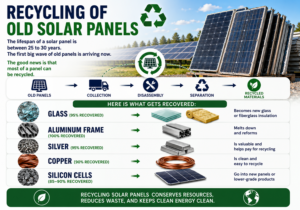
The lifespan of a solar panel is between 25 to 30 years. The first big wave of old panels is arriving now. The good news is that most of a panel can be recycled.
Here is what gets recovered:
Glass
(95% recovered) becomes new glass or fiberglass insulation
Aluminum Frame
(100% recovered) melts down and reforms
Silver
(95% recovered) is valuable and helps pay for recycling
Copper
(90% recovered) is clean and easy to recycle
Silicon Cells
(85-90% recovered) go into new panels or lower-grade products
Conclusion
Seven layers are put together to form a solar panel. The majority of the weight is made of glass. The frame is made of aluminum. The work of producing electricity is done by silicon. Tiny amounts of copper and silver that facilitate the flow of electricity are hidden inside. Solar panel recycling is also possible.
You’ll know exactly what are solar panels made of the next time you see one on a roof.
What are solar panels made of? The answer is glass, EVA, silicon, aluminum, copper, silver, and protective materials working together.