
You’ve probably been frustrated when you purchase a set of solar pathway lights, install them enthusiastically, then three months later they only light up for an hour. At the same time, a neighbor’s commercial-grade solar security light has worked flawlessly for three winters.
Why the difference? All solar lights follow the same four‑step process. But the quality of each component and the design philosophy behind the system determines whether your light performs well or ends up in the recycling bin.
So today in this article, we will discuss how solar lights work, the four-step process every solar light follows, 5 components that separate good solar lights from bad ones, differences between all-in-one and separated solar light systems, and some reasons why solar lights fail quickly.
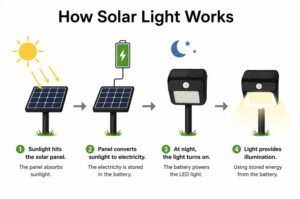
The 4-Step Process: How Solar Lights Work (The Basics)
All solar-powered lights run on the same basic cycle whether it’s a $15 decorative stake or a $2,000 street light. Here’s the complete explanation.
Step 1 – Daylight Absorption (The Photovoltaic Effect)
During the hours in which sun is out, the silicon solar panels convert sunlight into a direct voltage or current. This is due to the photoelectric effect.
- Monocrystalline panels are dark black, more efficient (18–22%), and perform better in low light.
- Polycrystalline panels have a blue speckled appearance, are slightly less efficient (15–17%), but cost less.
For the same physical size, a monocrystalline panel will generate more power, an important factor when space is limited (such as on an all‑in‑one fixture).
Step 2 – Energy Storage (The Battery)
The light is not directly powered by the electricity produced by the solar panel. Rather, it enters a rechargeable battery to be stored.
- During sunny hours, the battery charges.
- At night, the battery discharges to run the LED.
The primary determinant of how long your light will operate, particularly on overcast days, is the type and capacity of the battery.
Step 3 – Automatic Activation (The Controller & Sensor)
When the sun sets, something must turn the light on. That job belongs to two components:
- Photocell (light sensor): The photocell (light sensor) that detects ambient light levels which causes the sensor to close the circuit when light falls below its threshold at dusk. The system deactivates streetlights at dawn by opening the circuit.
- Charge controller: The charge controller system controls power distribution to protect batteries from two dangerous charging states which include overcharging and over-discharging.
PIR (passive infrared) motion sensors are also a common feature of modern solar lights. In that design, the light explodes to full brightness after remaining in a low-power sleep mode until motion is detected.
Step 4 – Illumination (The LED)
Finally, the stored energy powers one or more light‑emitting diodes (LEDs) .
LEDs are the ideal choice for solar lighting because they:
- Very little electricity is used in relation to brightness (lumens per watt).
- Works 50,000+ hours (more than ten years of nightly use).
- Turn on instantly with no warm‑up time.
It is the LED chip itself that determines the actual brightness, color temperature (warm white ~3000K versus cold white ~5000K) and beam pattern, apart from the lens or reflector in the fitting.
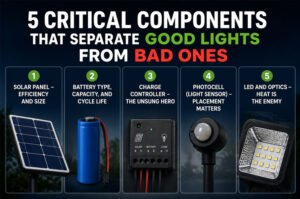
5 Critical Components That Separate Good Lights from Bad Ones
Now you know about the basic process of how solar light works. Let’s explore the five elements that greatly affect the quality.
1:Solar Panel – Efficiency and Size
In the same quantity of sunlight, a bigger panel gathers more energy. Low-cost consumer lights frequently have small panels (0.5–2 watts) that are unable to fully recharge the battery on a brief winter day.
- Consumer all‑in‑one: Panel is small and built into the fixture. Often shaded by the light housing itself.
- Commercial separated system: Panel is large (10–100+ watts) and mounted separately, allowing you to aim it directly at the sun.
What to look for: Panel wattage clearly stated. The panel should be large enough to recharge the battery in 4–6 hours of good sunlight because the more is better.
2:Battery Type, Capacity, and Cycle Life
More often than any other part, batteries fail quickly. Everything depends on the battery’s quality.
- Ni-MH is the worst. Found in very cheap lights, it lasts only 300–500 cycles and performs poorly in cold weather.
- Standard Li-ion is common in mid-range consumer lights. It lasts 500–800 cycles and works fairly well, but it degrades quickly in high heat.
- LiFePO4 is the premium choice for high-end consumer and commercial lights. It lasts 2,000–5,000 cycles, handles heat better, and is safer. It costs more but lasts years longer.
- AGM / Gel (sealed lead-acid) is used only in commercial separated systems. It lasts 800–1,200 cycles and performs excellently in extreme cold, but it is heavy.
Finally, understand autonomy, how many cloudy days the light can run without sun. Cheap lights offer 1–2 days. Commercial systems offer 5–7+ days. This single number often explains why one light fails in winter while another keeps working.
3:Charge Controller – The Unsung Hero
The charge controller has a significant impact on performance, although many people ignore it.
- PWM (Pulse Width Modulation): Inexpensive and simple. Works adequately for small systems but wastes some energy.
- MPPT (Maximum Power Point Tracking): 20–30% more efficient but more costly. Particularly in low light or overcast conditions, MPPT controllers continuously adapt to get the maximum power from the solar panel.
Most affordable solar lights use PWM. Any separated commercial system worth buying should use MPPT.
4:Photocell (Light Sensor) – Placement Matters
A photocell works only if it can see ambient light. On poorly designed fixtures, the photocell is mounted where the light’s own LEDs can shine back into it at night, causing the light to flicker or turn off prematurely.
What to look for: A photocell either mounted on a different distant sensor wire or on top of the fixture, away from the LEDs.
5:LED and Optics – Heat Is the Enemy
LEDs themselves have a long operational lifespan but they also produce a lot of heat. The LED will experience permanent brightness reduction through time because its heat needs to be managed properly.
- Good design: Aluminum housing that acts as a heat sink.
- Poor design: Thin plastic housing with no thermal management.
Light is directed by optics, which include lenses and reflectors. Budget lighting solutions emit light that spreads throughout all directions. Quality lights focus it where you need it.
The Big Difference: All-in-One vs Separated Solar Light Systems
This is the very important thing that you should know as a buyer because this will help you to choose the right type of solar lights according to your needs.
All-in-One (Integrated) Systems
One housing houses the solar panel, battery, LED, and sensor. You can easily find these on Amazon and in garden stores
- Pros: Very easy to install. Costs less at the start ($20–$150). Often comes with app controls.
- Cons: The battery only lasts 1–2 cloudy days. You can’t move the panel separately to face the sun. Difficult or impossible to repair. Works poorly during dark, northern winters.
Separated (Modular) Systems
These are common in industrial and commercial lighting. The light fixture and solar panel are not connected. Additionally, the battery pack is independent (usually on the pole in a weatherproof casing).
- Pros: Battery lasts 5–7+ days without sun. You can aim the panel directly at the sun for more power. You can replace single parts if they break. Works reliably even in bad weather.
- Cons: Starting cost is expensive ($300–$2,000+). Harder to set up and install. Too large or industrial-looking for small gardens.
Conclusion
Sunlight is converted into electricity by solar lights, which then store that energy in a battery for night lighting. Even if the procedure is simple, the quality of its components determines whether a light is good or awful. A well-made lamp will provide you with free electricity and brilliant nights for years without requiring any repair.