
How to become a solar installer is one of the most searched career questions in the renewable energy industry right now. Let me tell you what the expensive courses and glossy certification guides won’t admit. You do not need a $2,000 NABCEP certificate to get on a roof tomorrow. In fact, the majority of solar companies will pay you to learn because they are in dire need of someone with a driver’s license and functional knees. The only people telling you to spend months in a classroom first are the people selling the classrooms.
The 2026 market has shifted. The ITC reset is here. Third-party ownership is booming. Installers are currently the single biggest barrier in the solar sector, not equipment or permits. In particular, installers who are prepared to put in a lot of effort, arrive on schedule, and not complain about the heat.
In this article, we will discuss how to become a solar installer, step-by-step roadmap, give you proper guidelines and tips to complete each step, and a 90 day roadmap to become a successful solar installer.
How to Become a Solar Installer With Zero Experience
Forget the certification rabbit hole. The fastest path into solar installation requires exactly three things: work boots, a driver’s license, and the ability to lift 50 pounds repeatedly.
Solar companies have a two-tier workforce. The Solar Helper (moves panels, mounts racking, hands tools, earns $18–$24/hour) and the Lead Installer (NABCEP certified, handles wiring, earns $28-$30 per hour). The Helper role requires zero experience. Zero certification. Zero classroom time.
Step 1: The “Zero Experience” Hire
How to get hired as a Helper in 7 days:
- Skip the major job boards. Your goldmine is Craigslist under “skilled trades” and local electrical union hall bulletin boards. Small-to-mid sized solar contractors post there first because it costs nothing.
- Compose a one-paragraph email. The subject line reads, “Ready to haul panels tomorrow.” Body: “I don’t fear heights, I have steel-toe boots, and I own a truck. When can I begin learning?”
- Get your OSHA 10 online. This is the one piece of paper worth having before Day 1. It takes roughly 6 hours and costs $60 dollars. This is not the same as OSHA 30. That is for site supervisors. You are not a site supervisor.
That is it. Everything else, wiring, inverters, rapid shutdown, you will learn while getting paid.
How to Become a Solar Installer If You Are an Electrician or Roofer
If you are already an electrician or a roofer, stop reading the beginner guides. They are not for you.
Step 2: The Electrician or Roofer Shortcut
If you are a roofer then you are already familiar with structural load, weatherproofing, flashing, and how to safely navigate a pitched roof. Half the work is done. You have an electrical gap. You require roughly 40 hours of DC wiring basics, specifically, how to avoid harming yourself when connecting modules in series. Look for a nearby solar provider that will provide you with a two-week master electrician. Clean attics are more common than roofers who want to learn solar, so they will fight for you.
If you are an electrician then you already understand AC/DC, conduit, grounding, and the National Electrical Code. Your shortcut is brutal and simple: skip the entry-level NABCEP Associate entirely. Go straight for the NABCEP PV Installation Professional certification.
It requires 58 hours of advanced training and 2,000 hours of field experience, but the secret is that your existing electrical hours count toward most of that. You can cram the solar-specific material in two weeks.
The financial upside for electricians is immediate. In 2026 markets, journeyman electricians transitioning to solar see a 15-20 percent wage jump within 90 days. Most solar installers can mount panels. Very few can troubleshoot a faulty disconnect without calling a real electrician. Be that person.
How to Become a Solar Installer Without Wasting Money on Certifications
This is an honest, free of marketing jargon, breakdown of certificates in 2026.
Step 3: The Certification Reality
No certification at all is required for 100 percent of Helper and Apprentice roles. Not a single employer will ask for it on Day 1.
NABCEP PV Associate
NABCEP PV Associate ($300 plus exam): This is a resume padder. It proves you know the difference between a micro inverter and a string inverter. It does not qualify you to touch live wires. Useful if you have zero construction background and need to show you are serious. Otherwise, skip it and let your first employer pay for it after 90 days. Many will.
NABCEP PV Installation Professional
NABCEP PV Installation Professional ($550 plus exam plus 2,000 field hours): This is the real license. It is required for Lead Installer roles, for pulling permits in many jurisdictions, and for any job title that includes the word “supervisor.” You cannot get this without 2,000 field hours. That is roughly one year of full-time work. Do not stress about this on day one. Stress about this when you are ready to stop hauling panels and start telling other people where to put them.
The 2026 rule of thumb: Get hired as a Helper. Work for six months. If you love the job, ask your employer to pay for your NABCEP Associate. Work another six months. Then take the PV Installation Professional exam. If you try to do it in reverse order, you will spend $850 on certifications that sit on your wall while you wait for someone to give you field hours. Do not be that person.
How to Become a Solar Installer and Handle the Real Job Conditions
Every other article on solar installation is written by people who have never spent an August afternoon inside a residential attic. Here is the reality that the certification courses omit.
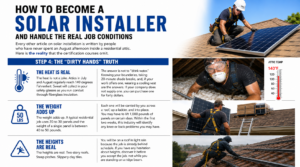
Step 4: The “Dirty Hands” Truth
The Heat Is Real
The heat is not a joke. Attics in July and August regularly reach 140 degrees Fahrenheit. Sweat will collect in your safety glasses as you run conduit through fiberglass insulation. The answer is not to “drink water.” Knowing your boundaries, taking 20-minute shade breaks, and, if your work offers one, wearing a cooling vest are the answers. If your company does not supply one, you can purchase one for forty dollars.
The Weight Adds Up
The weight adds up. A typical residential job uses 20 to 30 panels and the weight of a single panel is between 40 to 50 pounds. Each one will be carried by you across a roof, up a ladder, and into place. You may have to lift 1,000 pounds of panels on certain days. Within the first two weeks, this industry will identify any knee or back problems you may have.
The Heights Are Real
The heights are real. Two-story roofs. Steep pitches. Slippery clay tiles. You will be on a roof in light rain because the job is already behind schedule. If you have any hesitation about heights, discover it before you accept the job, not while you are standing on a ridge beam.
How to Become a Solar Installer Legally
The single most confusing part of becoming a solar installer is licensing. Here is the truth that will save you months of confusion.
Step 5: The License Loophole
Most states do not require a license to physically install solar panels if you are working under the supervision of a licensed master electrician. You are not an electrician. You are the installer. The license belongs to the company or the crew lead. This means you can legally install solar in over 30 states with zero personal license.
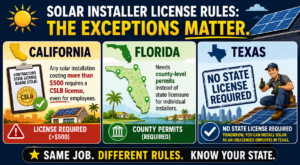
The exceptions matter:
- Any solar installation costing more than $500 in California requires a (Contractors State License Board) license, even for employees.
- Florida needs county-level permits instead of state licensure for individual installers.
- There is absolutely no state license required in Texas. Tomorrow, you can install solar as an unlicensed employee in Texas.
The loophole strategy: Find a company with a licensed master electrician on staff. Work under their license for one to two years. Then decide if you want to get your own license. Most installers never do. They stay as crew leads, making 35−40 an hour, letting the company’s license cover their work. That is perfectly legal and extremely common.
How to Become a Solar Installer in 90 Days
Your 90-Day Timeline
Days 1–7
Get OSHA 10 online ($60, 6 hours). Update your resume with any physical labor history. Apply to 10 Helper jobs using the email template above.
Days 8–14
Follow up on applications. Walk into local solar supply warehouses if you have no offers yet. Accept any Helper position that gets you on a roof.
Days 15–30
Show up every day. Stay off your phone. Carry the extra panel without being asked. Learn microinverters vs string inverters by asking questions.
Days 31–90
After 90 days, ask your employer to pay for your NABCEP PV Associate course. Most will say yes. Decide if you want to stay on tools or move toward lead installer.
Conclusion
Becoming a solar installer doesn’t require a degree or a costly course. Boots, a license, and a desire to put in a lot of effort are required. Become a helper first. Acquire knowledge while working. Allow your employer to cover the cost of your training. You can advance from lugging panels to managing a workforce for forty dollars an hour in less than two years. Your presence is the only thing lacking. This week, get OSHA 10. Forward those emails. Solar businesses are holding out.