
The main reason why people want DIY is due to the high cost of professional installation, costs between 20,000 to 30,000, while a DIY starter kit costs around $7,000.
In this article, we will discuss can you install solar panels yourself, what DIY solar actually means, the difference between DIY and professional, risks of DIY solar, the regulatory wall, and the benefits of both DIY and professional.
Can You Install Solar Panels Yourself? (The Short Answer)
The short answer is “yes”. You can install a solar panel yourself on most residential properties.
You can install a solar panel, but it does not mean you can do this. DIY solar installation is not for everyone. Before purchasing a single panel, you must take into account many more factors, such as safety, local permission regulations, and insurance consequences.
What DIY Solar Actually Means
The DIY solar exists on three different levels. You have to understand all the levels to choose the right one for you.
Can You Install Solar Panels Yourself With Full DIY
Everything is done by you, including design, wiring, mounting, permitting, and final electrical connections. The most challenging choice is not advised for beginners.
Can You Install Solar Panels Yourself With Hybrid DIY
You run the conduit and mount the panels. The last connections to the inverter and grid are then completed by a certified electrician. This is the best option for the majority of homeowners.
Can You Install Solar Panels Yourself With Kit DIY
You purchase a manufacturer’s pre-engineered kit. The kit includes every part, assistance, and instruction. This is ideal for beginners and makes the process much simpler.
Most realistic DIYers choose the hybrid or kit approach. Very few people should attempt full DIY.
Can You Install Solar Panels Yourself and Save Money?
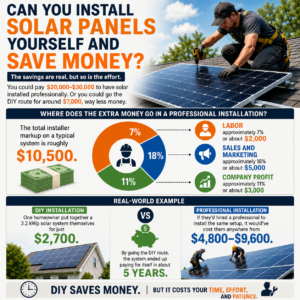
The savings are real, but so is the effort. You could pay 20,000–30,000 to have solar installed professionally. Or you could go the DIY route for around 7,000, way less money.
Where does the extra money go in a professional installation?
- Labor: approximately 7% or about $2,000
- Sales and marketing: approximately 18% or about $5,000
- Company profit: approximately 11% or about $3,000
The total installer markup on a typical system is roughly $10,500.
Real-world example: One homeowner put together a 3.2 kwp solar system themselves for just 2,700. If they’d hired a professional to install the same setup, it would’ve cost them anywhere from 4,800 to $9,600. By going the DIY route, the system ended up paying for itself in about five years.
DIY saves money. But it costs your time, effort, and patience.
The Biggest Risks of DIY Solar
DIY solar is not just about saving money. There are real risks you cannot ignore.
Risk 1: Safety Hazards
Work on roofs is risky. The biggest risk is falls. Electrical errors can result in fires, shocks, or undetected problems that show up months later. The entire system could go short by a single incorrect wiring arrangement, such as connecting solar panels before the batteries.
Risk 2: Poor Performance
Small errors result in significant losses. The output of a single panel can be decreased by 30 to 40 percent by shading merely 10 percent of it. You may lose five to eight percent of your yearly energy production if your tilt angle is ten degrees off. Wire connections that are poorly connected can lose two to five percent of their value.
A professional installer would catch these issues. A DIY beginner might not even know they exist.
Risk 3: No Export Payments
Net metering rules vary by utility. Some utilities require professional installation before they will approve your DIY system for grid connection. Before you start make sure to check with your local utility.
Risk 4: Warranty and Insurance Problems
The warranty can be canceled if you self-install your system. Your home insurance policy may not cover a DIY solar array. And when you sell your home, a DIY installation could reduce property value instead of increasing it.
The Regulatory Wall: Permits and PE Stamps
Many DIYers hit a surprise regulatory wall. Solar permits require a Professional Engineer (PE) stamp in several locations.
Here is how different states compare:
- California: PE stamp required for systems larger than 10 kW; permit timeline ~29 days
- Texas: PE stamp requirement varies by city (check locally); permit timeline ~28 days
- Florida: PE stamp required, mandatory for all systems; permit timeline ~34 days
Without a PE stamp, your permit application may be rejected. Simplified permission is available in some cities, such as California’s Solar APP+, but not everywhere.
Bottom line: Check with your local building department before you buy a single solar panel.
Best of Both DIY and Professional (The Hybrid Approach)
Most homeowners should not do full DIY. But most should not pay $30,000 for a professional installation either.
The hybrid approach is the sweet spot.
You do: Mounting panels on your roof or ground, running conduit, and basic mechanical work.
You hire: For the last connections to the grid, panel, and inverter.
Benefits of this Approach:
- You save most of the labor cost (you do the unskilled heavy lifting)
- You eliminate electrical safety risks
- You keep warranty and insurance intact (an electrician signs off)
- You get a PE stamp if needed for permits
For majority of the homeowners, this is the best approach.
Who Should DIY vs Who Should Hire a Pro
Good fit for DIY or Hybrid Approach:
- You are comfortable on a ladder or roof
- You have basic electrical understanding (or will hire an electrician for final connections)
- You have time to research, permit, and manage the project
- You want to save $10,000 or more
Good to Hire a professional:
- You are uncomfortable with heights or electricity
- Your jurisdiction has strict PE stamp requirements
- You want export payments or simplified net metering
- You value warranty and insurance certainty over maximum savings
Conclusion
So, now you know that you can install solar panel yourself but the real question is whether you should. Real money is saved by DIY solar, frequently $10,000 or more. But this also include risks like performance, safety, and permits.
The best approach that is perfect for most of the homeowners is DIY or hybrid. You mount the panels. A licensed electrician handles the final connections. This gives you most of the savings with much less risk.
Call your local building department, before you buy anything. Ask about permits, PE stamps, and inspection requirements. Then decide if DIY solar is right for you.