
The sun goes down, and your solar panels are sitting there on the roof. Do they still make power? No. The solar panels do not provide power at night but this does not mean your home goes dark. Between net metering and solar batteries, your house can stay powered all night long.
In this article, we will discuss do solar panels work at night, why solar panels stop at night, does moonlight make solar panels work, how solar homes stay powered at night, compare net metering and solar batteries, and new technology that works at night.
Do Solar Panels Work at Night?
No, solar panels do not provide power at night. To generate electricity, they require sunshine. The photovoltaic effect stops and no electricity is generated in the absence of sunlight. This does not mean that your house becomes dark.
Solar homes can keep the lights on at night in a couple of ways. One is net metering, it lets you push extra daytime energy back to the grid, and later you draw on those credits once it’s dark out. Second, extra electricity generated throughout the day is stored in solar batteries for use after sunset. Both are common and efficient fixes.
Moonlight is too weak to produce anything you can actually use as power. In fact it is about 350,000 times weaker than direct sunlight. This article explains these things in detail.
Why Solar Panels Stop at Night
If you want to know why solar panels stop at night then you first must understand how they work during the day.
Solar panels consist of silicon cells. Electrons are released when sunlight strikes these cells due to its energy. This produces a current of electricity. Out of the panel, that current enters the grid or your house.
This process is called the photovoltaic effect. It only happens when photons (light particles) hit the panel. At night, there are no photons hitting the panels. The electron movement stops. So does the electricity.
It is that simple. No sunlight = no electricity.
Does Moonlight Make Solar Panels Work?
Here is a common myth. Some people think moonlight can power solar panels. Here is the truth.
Moonlight is reflected sunlight. So technically, it is still sunlight. The intensity is pretty weak.
Moonlight Facts
- The intensity of moonlight is approximately 0.0002% that of direct sunlight
- This intensity is 350,000 times weaker as compared to sunlight
- Even under a full moon, panels produce around 0.3% of daytime output
- That output is not enough to trigger most inverters
What is an inverter?
The DC power from your solar panels is transformed into AC power for your house by an inverter. A minimum voltage is needed for inverters to activate. Moonlight simply cannot produce enough power to reach that minimum.
Bottom line: Moonlight cannot power your home. It is not a usable source of electricity. Do not count on it.
How Solar Homes Stay Powered at Night
At night, solar panels stop to function. But your home does not go dark. Here are the two ways solar-powered homes stay lit after sunset.
Solution 1: Net Metering
Your solar panels often end up creating more electricity than what you end up using each day. That extra energy goes to the grid. Your utility company gives you credits for that energy.
At night, you draw power from the grid. The credits you earned during the day cover the cost. This is called net metering. It is like using the grid as a giant, free battery.
Net metering is available in most states but not all. Check with your utility company.
Solution 2: Solar Batteries
A solar battery basically keeps the extra energy your panels manage to make during the day. Then at night you end up using that stored power, directly from the battery, rather than using electricity from the grid.
Benefits of batteries:
- You keep your power even during grid outages
- You depend less on your utility company
- You can save money on time-of-use rates (using stored power during expensive peak hours)
Which solution is better?
Net metering has lower upfront costs. The storage part is basically handled by your utility, so you are not really dealing with the batteries. Batteries do give you backup power during blackouts, but they usually cost more in the long run. A lot of homeowners choose this kind of mix, like a battery for those emergency moments, plus net metering for daily use, which is pretty common.
Net Metering vs Solar Batteries: Which Is Right for You?
The nighttime problem is solved by both net metering and batteries. But they work differently. Here is a simple breakdown:
Net Metering:
- No upfront cost
- Works automatically with your utility
- No maintenance
- Does not work during grid outages (you go dark with your neighbors)
- Only available where net metering policies exist
Solar Batteries:
- Upfront cost ($5,000-$15,000)
- Works during grid outages
- Requires maintenance
- Energy independence
- Available everywhere
Which should you choose?
If your utility offers net metering, start there. It’s probably the cheapest route, to get power at night. If you need backup power during outages, or if your utility doesn’t really offer net metering, then consider a battery. A lot of homeowners pick net metering first then add a battery later, kind of as a second step.
What If You Have Neither Net Metering Nor a Battery?
Some people live in areas without net metering. Others cannot afford a battery. What happens then?
If you have neither net metering nor a battery, here is what happens:
- Your panels power your home during the day
- Any extra daytime power goes to the grid (you may or may not get paid)
- At night, you buy power from the grid like everyone else
- Your solar system reduces your daytime electricity costs but not your nighttime costs
Is solar still worth it?
Yes. Solar panels lower your total electricity bill even in the absence of a battery or net metering. During the day, you just use less grid power. The panels eventually pay for themselves even if the savings are less than with net metering.
Solar Panels on Cloudy Days vs Night
Yes, but less effectively. On cloudy days, solar panels only generate 10–25% of their rated energy. That is still enough to power your home partially. The difference between cloudy days and nights is that there is still some sunlight on cloudy days. Photons still reach the panels. On a night, there are zero photons. Cloudy days reduce production. Nights eliminate it completely.
What About New Technology That Works at Night?
Scientists are working on solar panels that generate power at night. The technology exists but is not ready for your roof yet.
Researchers at UNSW Sydney and other institutions are developing thermoradiative diodes. These devices generate power from infrared heat escaping into space at night. The idea works. The problem is the output.
Today these devices kick out roughly 50 milliwatts per square meter when it is night time. A normal solar panel on the other hand gives around 200 watts per square meter in direct sunlight, so yeah. In other words nighttime tech is only about 0.02% as strong as daytime solar. It cannot power your home.
What is radiative cooling?
Solar panels radiate heat into the cold night sky at night. The panel becomes cooler than the surrounding air. That temperature difference can generate small amounts of electricity. It is real science. But it is years away from being useful for homeowners.
Bottom line: Exciting research exists. Do not expect it on your roof anytime soon. For now, net metering and batteries are your only practical options.
Be Careful of Exaggerated Claims
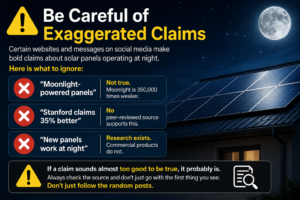
Certain websites and messages on social media make bold claims about solar panels operating at night. Here is what to ignore:
- “Moonlight-powered panels”, Not true. Moonlight is 350,000 times weaker.
- “Stanford claims 35% better”, No peer-reviewed source supports this.
- “New panels work at night”, Research exists. Commercial products do not.
If a claim sounds almost too good, to be true, it probably is. Always check the source and don’t just go with the first thing you see. Don’t just follow the random posts.
Conclusion
No, solar panels do not generate electricity at night. They need sunlight to work. But your home does not go dark. Net metering lets you use daytime credits at night. Batteries store extra power for after sunset.
Moonlight seems kind of flimsy, not enough to power your home. It’s about 350,000 times weaker than direct sunlight. Right now, some newer nighttime tech is being worked on, but it’s not out for homeowners yet, so you can’t really use it.
Solar panels work during the day. Net metering and batteries work at night. Together, they keep your home powered around the clock.