Think about going on an outdoor adventure with your solar power bank ready, but at the same time, you ask yourself how to get the most out of it. If you want maximum performance from your solar power bank, then you need to learn how to charge it properly. This sounds simple, but using the wrong charging method can reduce the performance of the solar power bank.
In this article, we will discuss how to charge solar power bank, two simple charging methods, the crucial first-time charge, and some advanced tips.
How to Charge a Solar Power Bank
It is necessary to initially charge your solar power bank completely through a wall outlet. For everyday usage, the wall outlet must be the primary charging source as it is the fastest and most reliable. Sunlight should be used only in case of slow, emergency recharge when no outlet is accessible.
The Two Charging Methods
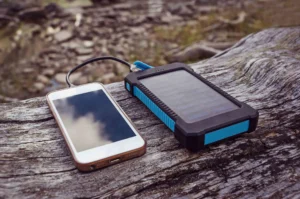
Any solar power bank can be charged in two different ways. The first method is fast and trustworthy, while the other one is very flexible but still slow. You need to be aware of both methods.
Method 1: Wall outlet charging (The Quickest and Most dependable Method)
When you have access to electricity, this is the main way you should charge your power bank.
What You’ll Require:
- Your solar-powered bank
- The USB wall adapter
- A USB cable of any type
Instructions:
- Connect the USB cable to the power adaptor. Using a power adaptor of good quality is always a wise choice. The device may be at greater risk of being damaged in case of a power failure, or unstable power may be supplied if third-party, cheap adapters are used.
- Check the external battery connection socket before making the connection, and also check that the USB cable is properly connected to the power bank input.
- Put the adapter into the wall socket.
- Charging is indicated by solid or blinking LEDs for most power banks. If all the LEDs are on or the light goes out, the device is completely charged.
Method 2: Charging via Solar (The Emergency Way)
Charging with solar power is the superpower of your power bank in off-grid scenarios. Expectation setting, however, is of utmost importance: solar charging is much slower than wall charging and is very much dependent on the environment.
What You Would Require:
- Your solar power bank
- Direct Sunlight
Instructions:
- In case your model features a foldable panel, fully open it. On the other hand, if the panel is integrated, then make sure that the whole surface is facing upwards.
- Solar panel placement should be such that it receives the most uninterrupted sunlight ever, while shaded areas must be completely avoided.
- The panel should be located in such a way that it gets the most of the sun’s rays. You can view it as trying to “capture” the maximum amount of sunlight.
- Look for a specific solar charging light or a change in the LED pattern to confirm it’s receiving solar power.
- Solar charging takes time. Leave it for several hours, repositioning it every few hours to follow the sun if you can.
The Crucial First-Time Charge
This is the step that most frequently gets overlooked and results in poor performance right from the start.
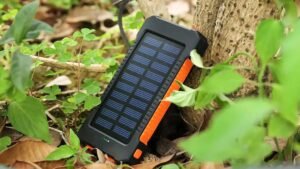
Full charging through a wall socket is a must before you attempt to use your solar power bank for the first time.
Why is This Step Important?
Battery Calibration: It helps in the precise measurement of the battery’s capacity by the internal battery management system.
Guarantees Best Performance: A lot of the time, the power banks are delivered with a bit of charge left. If you want to obtain the maximum benefits of your power bank, then it is better to fully charge it prior to the first use.
Supports Long-Term Health: It ensures the battery has a long and lasting life.
Do not rely on solar power for the first charge. Use the wall outlet method to ensure a complete, stable, and fast initial charge.
Tips for Maximum Speed
Just putting your power bank on a rock isn’t the proper way to do solar charging. If you wish to get the quickest charge, then you have to follow the steps below.
Perfect Setting: A bright and sunny day with the sun at its highest point. The sun being clouded over, during winter, or at times of the day when the light is low, are all much less effective situations.
Keep it Cool: The battery requires sunlight, but too much heat can be harmful to it. If the power bank is already hot on the outside, shift it to a cooler spot where light is still coming through a bit. Do not put it on very warm surfaces such as car dashboards.
Clean the Panel: An inefficient solar panel is unclean or dusty. Before charging, use a gentle, dry cloth to clean the panel.
Manage Your Expectations: In a solar power bank, the common range of hours needed for a direct sunlight spot to get the full charge is usually between 25-50 hours. Its primary function is to recharge your gadget a bit or give emergency power, not to recharge completely from off quickly.
Understanding Your Power Bank’s LED Indicators
The blinking lights are the communication method of your power bank. Although the models differ, a standard pattern is:
Blinking LEDs: The power bank is in charging mode. Normally, a simple rule applies here to find the battery percentage as per the count of LED indicators. (e.g., 2 flashing means approximately ~50% charged.).
Solid LEDs: Charging is done, or the mentioned level is full.
No Lights: The power bank could be dead, in sleep mode, or not getting a charge.
Specific Solar Indicator: There are some models that depict a sun-shaped icon that is illuminated when solar power is being detected.
Advanced Tips
Use Pass-Through Charging Wisely: A few of the up-to-date power banks have a feature called “pass-through charging”, which lets you charge a gadget (like your smartphone) while the power bank is being charged (through solar or wall). Look into the manual to see if it allows this, but keep in mind it may produce heat.
Long-Term Storage: In case the power bank is not used for a longer time period of a month or more, recharge it between 50% and 80% and then keep it in a cool and dry place. Don’t keep it either at full charge or completely discharged because both conditions shorten the battery life.
Cycle the Battery: After some months, use the power bank until it is almost dead, then charge it completely to 100%. This practice will help with the battery level accuracy.