Do you want a house that can withstand the outage without flickering or that makes paying your power bills easier? If you still think that this is not possible, as it is now, you are wrong. The solar batteries allow you to accomplish all of this.
However, how is this made possible by solar batteries? To fully understand this, you first need to know the average cost.
In this article, we will break down how much do solar batteries cost. We will use simple examples and outline the benefits you can expect.
The Role of Solar Battery
Understanding the role of a solar battery is the first step to understanding its cost.
Without a Battery (Using Power as it’s Made): Consider a battery-free solar panel system as a tap that pours water straight into a cup. Only when the sun is shining and the tap is turned on can you utilize the water. Any extra water just goes down the drain.
With a Solar Battery (Your Personal Energy Reservoir): A solar battery functions similarly to a store of energy. On bright days, you add extra solar power. You may then draw on that energy during storms or at night when you need it most.
So, How Much Do Solar Batteries Cost?
We should get right to the point. EnergySage’s market data indicates that, before subsidies, the average cost of installing a house solar battery in 2025 is between $13,000 and $24,000.
The good news? The 30% federal tax credit can significantly reduce that number. Scroll down to know what factors influence the price and what you can expect for your budget.
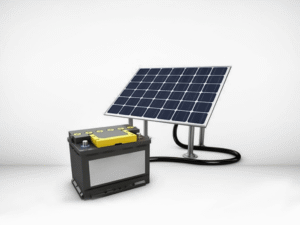
What Things Determine the Cost?
Several factors tell you why there are different costs of solar batteries.
- It matters how big the battery is. It will be cheaper to get a smaller one that only powers what you need rather than a larger one that can power your entire home.
- Some battery brands are premium, like Tesla and Enphase, and cost more, while others are just as reliable but easier on your budget.
- The majority of houses just have one battery at first, but if you want to power everything in case of an outage, you’ll probably need two or more, which raises the cost.
- Your home will also determine the ultimate cost. If your electrical system needs to be updated or if the installation site is difficult, the price will go up significantly.
Understanding Installation & “Hidden” Costs
The story doesn’t end with the battery unit. The additional parts that contribute to the overall installation cost should be understood.
Battery Unit & Hardware: The physical battery and its required components, like an inverter.
Labor & Installation: The cost for a certified electrician to safely install the system.
Electrical Panel Upgrade: If your current panel is outdated or full, an upgrade can cost $1,500 – $5,000.
Critical Loads Panel: A sub-panel that ensures your battery powers only your most important circuits during an outage. Costs $1,000 – $2,000.
Permits & Fees: This is done by your installer, but your estimate includes the price, which is usually between $500 and $1,500.
Why Should You Buy a Solar Battery?
A solar battery is a good addition to your solar system. These are some reasons why you should buy one:
- Blackout Protection: This is the ultimate advantage. Your lights remain on when the grid goes down. Your family stays comfortable, and your fridge stays cold.
- Increase Solar Savings: You can use the clean energy that your panels store during the night to increase your solar savings. Instead of using expensive electricity from the company.
- Energy Independence: You don’t have to rely on traditional electrical power anymore. This way, you can achieve energy independence and also control the energy costs
Real-World Examples: 3 Common Setups & Their Costs
To make this even clearer, let’s look at what you might pay for different levels of backup power.
- Basic Backup ($13,000 – $17,000)
Enough to provide comfort during an outage. This setup requires one battery will keep your lights on, your food cold, and your devices charged.
- Whole-Home Backup ($19,000 – $24,000)
Maximize your solar savings and power the majority of your home. This typically uses one large or two mid-size batteries to run your major appliances and significantly reduce your electricity bill.
- Total Energy Independence ($27,000+)
For complete off-grid capability or backing up everything in your home for days. This system uses multiple large batteries to power your entire household, including air conditioning and electric vehicle charging.
How the 30% Federal Tax Credit Saves You Money?
This is the most efficient method of cost reduction. 30% of the total installed cost of your solar battery system can be written off against your federal income taxes thanks to the federal investment tax credit (ITC).
You don’t give the government a cheque for 30% of the $22,000 cost of installing your solar battery. Instead, you pay $6,600 less in taxes when you file your annual federal income taxes.
This effectively lowers your net investment to $15,400.
Conclusion
Consider a solar battery not simply an expense but also an investment in the long-term stability of your house and your financial independence. It’s the secret to transforming your solar panels into a power source that runs nonstop, keeping your family comfortable during blackouts, and generating significant electric bill savings for years to come.
The greatest choice for your house and budget may be made by having an informed discussion with installers about how much do solar battery costs, the variables that affect them, and the available incentives.