You’re looking at your utility bill and you notice the bottom figure continues to increase. Your neighbor’s roof is now covered in gleaming black panels. And you’re wondering: would that even work for me? And how many would I actually need?
It’s the first question every homeowner asks when solar starts to feel real. And it’s a fair question. You don’t want to call an installer without a clue. You don’t want to be sold something you don’t need. You just want a straight answer.
In this article, we will discuss the answer to how many solar panels to power a house, helps you understand what this is actually mean, variables that you can control, the simple formula to find the write number, how to find actual sun hours, some hidden factors you should know, and what to do after you find your number.
So, how many solar panels to power a house? (The Straight Answer)
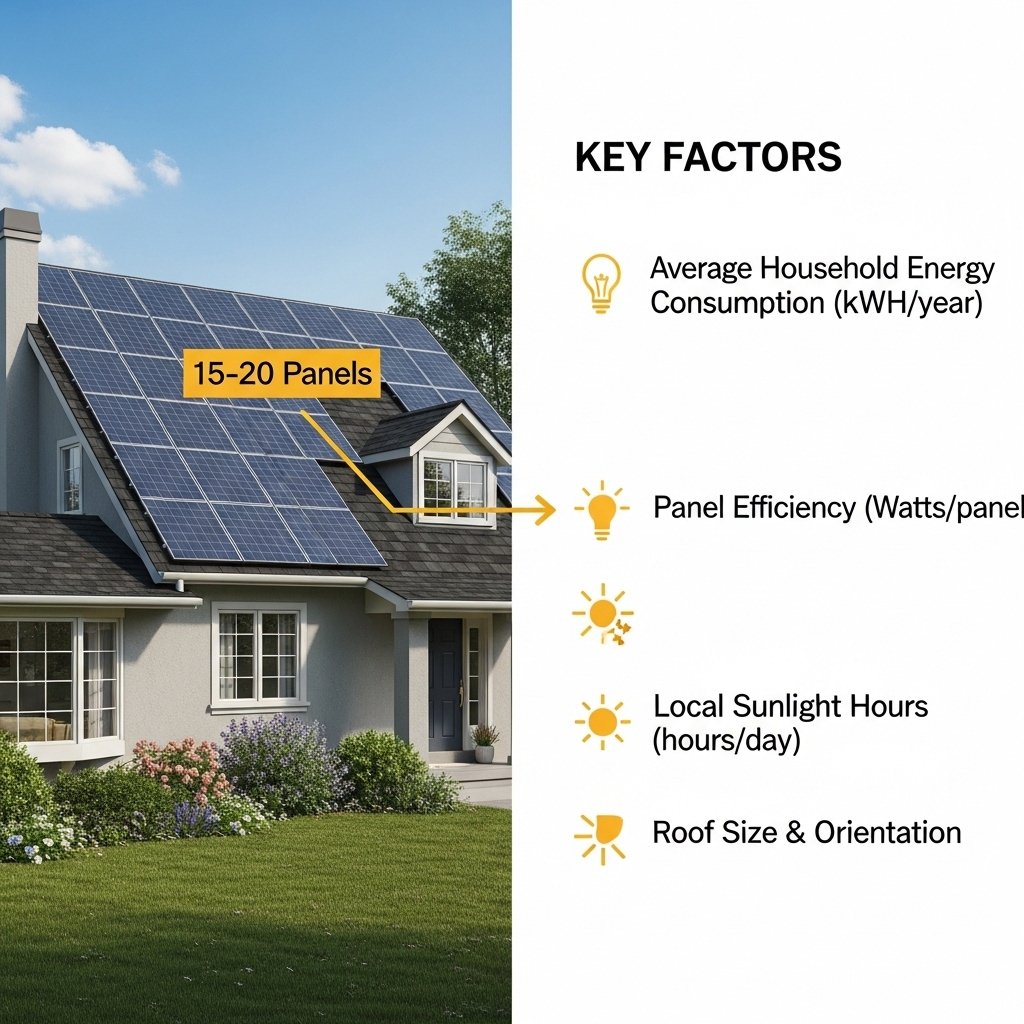
The average American home needs 15 to 22 solar panels. Better sunlight or less energy consumption are assumed by the low end (15 panels). The premium model (22 panels) depends on either higher energy use or less sun. Depending on your particular circumstances, your home may require more or less panels, but for most individuals, the solution is found somewhere in that window.
The Big Picture: What Does “Power a House” Actually Mean?
First we have to know exactly what “power a house” means, before we can dive into the numbers.
Homeowners who choose solar energy for their homes still need to maintain connection with their local power grid. The practice known as off-grid solar requires high expenses and complex procedures and it serves as the wrong solution for typical suburban residences.
The majority of people prefer solar systems that connect to power grids. Your solar panels establish a connection with the electrical grid. Your home receives electricity from the solar panels during daylight hours. The system sends any surplus electricity back to the grid which typically results in you receiving credits on your bills through net metering. You use electricity from the grid during nighttime just like you do at other times.
The question “how many panels to power a house” actually requires us to answer how many panels I need to install in order to generate enough electricity that matches my yearly consumption needs.
That’s the goal this guide will help you figure out.
The Three Variables You Actually Control
Here’s the good news. The math behind solar is simpler than most people think. You only need three numbers.
- Your Energy Usage (The Biggest Factor)
The solar system at your property must provide sufficient energy to fulfill your complete energy needs. A small apartment without air conditioning and with gas heating consumes 4000 kWh of energy during each year. A large residence which has a swimming pool pump system and an electric vehicle and central air conditioning can consume as much as 20000 kilowatt hours.
An average American home uses 10,000 and 12,000 kWh annually as their energy consumption
Where to find your number: Pull out your electric bill. Look for “kWh used.” Add up the last 12 months. That’s your annual consumption.
Pro tip: Look at all seasons, not just one month. Summer AC and winter heating can double your usage. A full year gives you the real picture.
- Your Sunlight (Location Matters More Than You Think)
Different types of sunlight produce different energy results. An Arizona panel generates more energy than a Seattle panel although both panels receive identical daylight duration.
Solar professionals use something called peak sun hours. The term “hours of daylight” does not describe this measurement. The measurement refers to “hours per day when the sun is strong enough to actually charge your panels.”
Here’s what that looks like across the country:
- The Southwest region which includes Arizona Nevada New Mexico and Southern California receives 5.5 to 6.5 peak sun hours.
- The Southeast region and Texas receive 4.5 to 5.5 peak sun hours.
- The Northeast Midwest and Mid-Atlantic regions experience 3.5 to 4.5 peak sun hours.
- The Pacific Northwest and Mountain West regions receive 3.0 to 4.0 peak sun hours although high-altitude areas experience stronger sunlight.
Why this matters: A home in Ohio requires 40% additional solar panels than a similar home in Phoenix because it receives 4.0 peak sun hours. Your location alone determines your solar panel requirements which can exceed 10 panels.
- Your Panel Wattage (Bigger Is Often Better)
There are specific design criteria for each solar panel installation. The solar panels generate electrical power which ranges between 350 watts and 450 watts. High-wattage panels produce more electricity than standard panels which leads to a requirement for fewer panels.
The trade-off: Higher wattage panels usually cost more upfront. Their installation requires fewer components which results in reduced installation efforts and less roof area needed. The financial calculations show that homeowners should select their maximum budget allowing for purchasing panels with the highest wattage rating.
Today, 400-watt panels are the sweet spot, widely available, reasonably priced, and efficient enough for most homes.
The Simple Formula (To Find Out the Number)
Your personal number can be determined through the following equation:
Number of Panels = Annual kWh ÷ (Peak Sun Hours × 365 × Panel Wattage × 0.8)
The system efficiency factor which exists at the end of the equation which shows “0.8” represents system performance. No system performs perfectly. Your output power decreases because of dust and heat and inverter losses and wiring resistance. Professionals use an 80% efficiency factor as a realistic baseline.
Let’s walk through an example.
Example: A home in Ohio using 11,000 kWh per year, with 4.0 peak sun hours, using 400-watt panels.
Step 1: Multiply peak sun hours by 365: 4.0 × 365 = 1,460
Step 2: Multiply by panel wattage: 1,460 × 400 = 584,000
Step 3: Multiply by efficiency: 584,000 × 0.8 = 467,200
Step 4: Divide annual usage by that number: 11,000 ÷ 467,200 = 23.5 panels
So this home would need roughly 24 panels to offset its full electricity use.
The same Phoenix house uses 5.5 peak sun hours which results in the following calculation:
5.5 × 365 = 2,007.5
2,007.5 × 400 = 803,000
803,000 × 0.8 = 642,400
11,000 ÷ 642,400 = 17.1 panels
With the same house and energy use, that would mean roughly 7 fewer panels just for location.
The Hidden Factors Installers Don’t Always Mention
The formula gives you a solid starting point. But real-world solar has more moving parts.
Roof Orientation and Pitch
The ideal roof design requires south-facing roofs which provide maximum sunlight collection throughout the entire day.
The solar energy production of east or west-facing roofs remains functional but requires installation of 10 to 20 percent additional solar panels to reach their annual output target. The sun hits them in the morning or afternoon, not all day.
North-facing roofs? The solution remains possible but people rarely choose it as their best option. Your roof needs north-facing panels which will prevent some installers from performing the installation work. Get multiple quotes.
Shade (The Silent Killer)
Even partial shade can slash your system’s output. A single tree covering one corner of your array can drag down performance across multiple panels, depending on how your system is wired.
What to do: Before you commit, get a site survey. A good installer would use tools like a solar pathfinder or drone imagery to chart shade patterns all year round. Unless they do, you have to look for someone who does.
Your Roof’s Age
The solar panels can work for 25–30 years. First, you should replace your roof when it approaches its final stage of existence. Your costs go up by $5,000 to $10,000 when you remove solar panels for reinstallation. Do it correctly the first time.
Future Changes
Do you buy an electric vehicle over the coming 5 years? Add a pool? A heat pump? Your electricity consumption may double as a result of these adjustments. You could wish you had created a larger system if you size it for today without considering tomorrow.
Consult your installer about future-proofing. It’s less expensive to oversize your system now rather than later.
Conclusion
Solar is a significant choice. It’s also one of the few self-paying house renovations. Your roof panels will decrease your electricity expenses while establishing fixed energy prices for the future and protecting you from future price increases and increasing your property’s worth.
You can proceed now that you have the right number and questions. Whether you’re calling an installer, inputting your address into Project Sunroof, or just starting to keep an eye on your energy consumption, you’re ahead of most.
The sun is waiting. Your roof is ready. Now you know what it takes.