Have you ever been left with nothing but a camera solar charger, and a dead solar battery? This question may arise if you’ve ever been camping, off the grid, or in an emergency. Can you use a camera solar charger to charge battery ? Well, the answer is simpler than you think. It depends on how batteries and solar chargers work together, how well the high terms of voltage align, their overall setup and output of current.
In this guide, we will explore what will happen when you use a camera solar charger to charge a solar battery, the circumstances in which they can charge a solar battery, and whether or not it’s a viable option for your energy requirements. Helping you understand when this setup works and when it doesn’t.
What are Camera Solar Chargers?
These are easy-to-carry, small solar chargers that help you charge small electronic devices or a digital camera via DC output and USB.
They usually have a built-in voltage controller and foldable solar panels, with a power range of 5 to 25 watts. If you have to charge small devices, then it works well. But if you want to charge larger batteries, such as in off-grid systems. This mainly depends on the sunlight, how much power the charger gives, and the size of the battery.
[ Answer] Can you use a Camera Solar Charger to Charge a Solar Battery?
When discussing whether can you use a camera solar charger to charge a solar battery or not, it is very important to understand these things first.
In short, it is only possible under some specific conditions.
The camera solar charger can charge small-capacity solar batteries or portable power stations that have built-in battery management systems (BMS), while they are not intended to charge large solar batteries directly, they can support low-wattage solar inputs.
How does it work?
If you have a portable battery, such as a mini Li-ion solar generator or a power bank that has solar input, and
If the DC output that matches the battery’s input range is available in the camera charger, and If the voltage and current are within the safe operating conditions, then charging is possible, although slowly. Let’s discuss the practical components to understand it easily.
Current and Voltage Compatibility Before you start charging a solar battery with a camera charger, make sure: The voltage output of the camera charger matches the required input voltage of the solar charge controller.
The output amperage is enough to activate the circuitry of the charge controller’s MPPT or PWM.
Example:
A solar battery with 12V and 10Ah, and has a small PWM controller, needs at least 12V at 1.5A to start the charging.
A solar camera charger with 20W under the sun exposure could provide 12V at 1.6A, which is enough, but only if the sunlight conditions are ideal.
Important Note:
It is not recommended to do direct charging without a solar charge controller, because it may damage the battery due to overheating, overcharging, or irregular supply of current.
Why is it Important to use a Solar Charge Controller
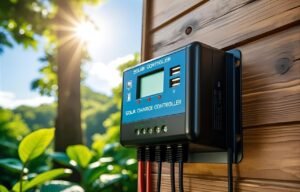
A solar charge controller is a must-have to safely connect a camera solar charger to a solar battery. This device prevents the battery from damage by regulating the current and voltage flow.
Steps to Setup:
- Connect the charge controller input terminal to the camera solar charger
- Connect the solar battery to the output terminals of the charge controller
- Make sure that the polarity is correct (+ to +, – to – )
- Finally, place the solar charger in direct exposure to the sun at an angle of 30-45 degrees.
Since the camera solar charger doesn’t always provide constant voltages, using an MPPT controller is best for maximum efficiency.
Camera Solar Charger Best Use Cases
Camera solar chargers are excellent at charging, but they might have trouble with full-size deep-cycle solar batteries.
- Small solar generators such as EcoFlow, Jackery, or Goal Zero ( make sure DC input compatibility )
- Batteries with a capacity of less than 10Ah, such as gel or 12V AGM batteries
- USB-C power banks that run on solar power
- LED light or communication device battery packs
Consider upgrading to dedicated 50W to 200W solar panels for larger battery setups, as they offer good voltage control and enough wattage for the storage of sustainable energy.
Factors that Affect Charging Efficiency
- Conditions of Sunlight
Time of day, cloud cover, and the direction of the panel highly affect the output. In partial sun, even a 20W panel might only produce 10- 12W.
- Efficiency of Panels
For better durability and performance, it’s a smart move to choose chargers that feature ETFE-coated monocrystalline cells because when you stack polycrystalline panels against monocrystalline ones, you’ll find that the former are a bit less efficient—around 20% less, to be exact.
- Connector and Cable Quality
The voltage drop is the result of a thin or damaged wire. Always use the waterproof connectors with heavy-duty, low-resistance DC cables,
- Condition of the Battery
Use brand-new, well-maintained batteries at all times because they respond better to gradual charging, and also, older batteries may have trouble accepting a charge from a low-output source.
Conclusion:
So, can you use a camera solar charger to charge a solar battery? Yes, but you need some essential things. You’ll need a charge controller, and a small battery is also preferable with proper voltage. While travelling, this technique is very useful despite its slow speed, for charging emergency power banks and small solar generators.
However, you should purchase larger solar panels and better charge controllers if you require more power. Large battery systems found in homes or off-grid cabins cannot be charged by a camera solar charger.