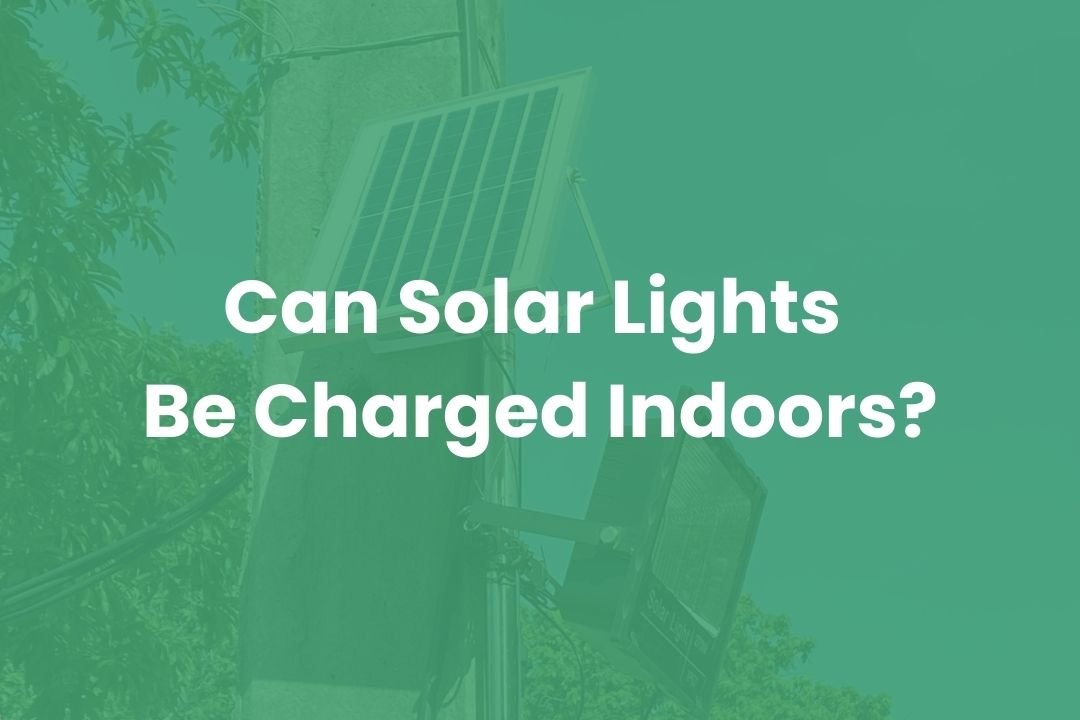
You brought your solar lights inside for the winter, or maybe your patio just doesn’t get full sun. You have left your solar light under a bright lamp because you heard it could charge indoors. The light produces minimal glow, which lasts only one hour after sunset. You feel upset because you think the product sold to you contains incomplete information. The statement about “indoor charging” presents a straightforward answer, which hides the essential truth that the process moves at a sluggish pace.
We show you exactly how little charge different methods deliver and, more importantly, how long it often takes for a partial charge.
In this article, we will discuss can solar lights be charged indoors, some methods of indoor charging, the rules you should follow, and things to avoid during indoor charging.
Can solar lights be charged indoors? (Short Answer)
Yes, solar lights can be charged indoors using artificial light, but with severe limitations. It is a slow, inefficient process that typically delivers only 10-50% of the energy of direct sunlight.
The indoor method of charging lights provides users with the best solution for maintenance charging because it allows them to recharge their lights during rainstorms that last no more than one week. The system does not provide a dependable solution for fully recharging their batteries from complete discharge.
Why Indoor Charging is a Struggle?
The main problem involves more than brightness because it deals with the specific light type. Solar panels are designed to transform all components of sunlight, which include substantial amounts of infrared and ultraviolet radiation. Most indoor artificial lights produce light through a narrow spectrum, which contains strong visible light but fails to deliver the wavelengths that solar panels require most.
Two technical specs determine an indoor light’s effectiveness:
Lumens (Brightness): For any energy exchange to be useful, a minimum input of 800+ lumens is required. A traditional 60-watt LED bulb is enough to provide this input.
Color Temperature (Light Quality): Lights in the “daylight” range (5000K to 6500K) perform significantly better than “warm white” (2700K to 3000K) bulbs because their spectrum is closer to that of the sun.

Method-by-Method Breakdown:
When you charge identical solar lights from a fully depleted state for 24-hour periods under different light sources, here’s what you can expect:
Method 1: Using a Specialized Plant Light
Performance: Best artificial option. Achieved approximately 40-50% state of charge.
How-To: Install the solar panel 6 inches below the grow light. The light must receive certification as “full-spectrum” or “broad-spectrum” according to its rating system.
The Result: Effective but niche. It works well if you already own one for plants, but buying one just for charging solar lights is rarely cost-effective.
Method 2: Using an Old-Style Light Bulb
Performance: Most reliable compmon household option. Achieved approximately 30-40% state of charge.
How-To: The installation requires using an old incandescent light bulb, which emits warm white light. The light should be positioned between 6 and 12 inches from the solar panel. The bulb will produce extreme heat requires you to maintain a safe distance from all flammable objects.
The Result: Surprisingly effective due to its broad, sun-like spectrum, but increasingly hard to find and very energy-inefficient.
Method 3: Bright Daylight LED Bulb
Performance: Moderate and practical. A 5000K LED bulb with a 100W (1600 lumen) equivalent reached approximately 15–25% charge.
How-To: You should select the most powerful “daylight” LED bulb that is available in the market. You should position the solar panel as close to the fixture as possible, which includes placing it directly on top of the fixture.
The Result: The best balance for most people. It won’t deliver a full charge, but it can provide enough for several hours of glow after a full day of charging.
Method 4: Window Sill Placement (The Hybrid Approach)
Performance: Highly variable. The south-facing window produces approximately 25 to 75% outdoor light through its window, which faces no obstructions. The north-facing windows and double-paned Low-E windows block essential UV and IR light while their performance remains inadequate.
How-To: Clean the window thoroughly. Place the solar light so its panel is pressed directly against the glass.
The Result: Often better than pure artificial light, but results depend entirely on your specific window. It’s always worth a try first.
The Golden Rules for Any Indoor Charging Attempt
- Clean the Panel First: You need to start cleaning the panel regularly because panel dust blocks 20% of the already-limited illumination.
- Distance is Critical: Light intensity follows the inverse-square law. Halving the distance quadruples the light hitting the panel. Get the light source as close as safely possible.
- Time is Not Optional: Don’t expect results in a few hours. Plan on leaving the light under the source for a minimum of 12-24 hours for a meaningful boost.
- Check the Manual Switch: During shipping, most products today have an ON/OFF switch; if it’s not ON, the solar lights will not charge.
Things Not to Do:
- Using Dimmable Lights or Smart Bulbs on a Dim Setting: The light brightness and light spectrum output both decrease when dimmers are used. The bulb needs its highest brightness level to function after it has been fully charged.
- Charging Through Lampshades or Diffusers: These can cut usable light by 50% or more. You should either take them away or put the panel above their current location.
- Expecting a “Full” Charge: Your expectations need to be managed through this process. Once charged from sunlight on a bright day, the light lasts about 8 hours, but with a day indoors, it drains and delivers light just for 2-3 hours.
- Using Warm-White LEDs: Their 2700K-3000K spectrum is the worst for solar charging. Daylight (5000K+) bulbs should always be your first choice.
Choosing Lights That Handle Indoor Charging Better
Your task requires you to identify particular charging equipment features that will help you to select the correct product for your indoor device charging requirements.
- Detachable Solar Panels: Users can place the small panel on a windowsill while they keep the light body outside their garden space.
- Larger Panel Surface Area: The expanded surface area of the panel system enables better indoor light collection to function properly during times of dim indoor lighting.
- Lithium-Ion Batteries: They perform better with partial state-of-charge cycling because users can charge their batteries up to 30% capacity.
- Backup USB Charging Port: Users who own modern devices can use the micro-USB port to connect their devices, which allows direct battery charging without the need for panel system operation.
Conclusion:
The method of indoor charging functions as a permanent solution because it requires time to operate based on the fundamental laws of physics. The system needs direct sunlight to establish dependable operations that can continue for an extended period. The system functions as a temporary solution to extend device operation time during extended periods of cloudy weather and wintertime because it maintains power for storage in a garage.
The most accurate results will occur when you place your lights in actual sunlight. Use a bright “daylight” LED bulb as your indoor charging tool, place the panel inches from the source, and be patient.
The solution for people who depend on indoor methods should include products that offer detachable panels together with USB charging ports, which will make the process of accomplishing tasks an easy plug-and-play operation.